
We Do It Right
International Commercial Terms 2020
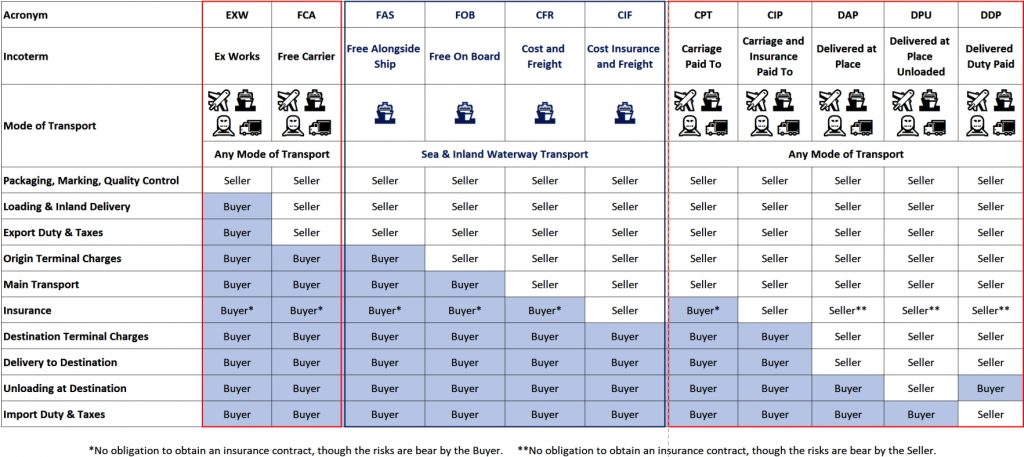

Incoterms® – international commercial terms
RULES FOR ANY MODE OR MODES OF TRANSPORT
EXW | Ex Works
EXW (insert named place of delivery) Incoterms®2020
“Ex Works” means that the seller delivers the goods to the buyer
- when it places the goods at the disposal of the buyer at a named place (like a factory or warehouse), and
- that named place may or may not be the seller’s premises.
For delivery to occur, the seller does not need to load the goods on any collecting vehicle, nor does it need to clear the goods for export, where such clearance is applicable.
FCA | Free Carrier
FCA (insert named place of delivery) Incoterms®2020
“Free Carrier (named place)” means that the seller delivers the goods to the buyer in one or other of two ways.
- First, when the named place is the seller’s premises, the goods are delivered
- when they are loaded on the means of transport arranged by the buyer.
- Second, when the named place is another place, the goods are delivered
- when, having been loaded on the seller’s means of transport,
- they reach the named other place and
- are ready for unloading from that seller means of transport and
- at the disposal of the carrier or of another person nominated by the buyer.
Whichever of the two is chosen as the place of delivery, that place identifies where risk transfers to the buyer and the time from which costs are for the buyer’s account.
CPT | Carriage Paid To
CPT (insert named place of destination) Incoterms®2020
“Carriage Paid To” means that the seller delivers the goods – and transfer the risk – to the buyer
- by handing them over to the carrier
- contracted by the seller
- or by procuring the goods so delivered.
- The seller may do so by giving the carrier physical possession of the goods in the manner and at the place appropriate to the means of transport used.
Once the goods have been delivered to the buyer in this way, the seller does not guarantee that the goods will reach the place of destination in sound condition, in the stated quantity or indeed at all. This is because risk transfers from seller to buyer when the goods are delivered to the buyer by handing them over to the carrier; the seller must nonetheless contract for the carriage of the goods from delivery to the agreed destination. Thus, for example, goods are handed over to a carrier in Las Vegas (which is not a port) for carriage to Southampton (a port) or to Winchester (which is not a port). In either case, delivery transferring risk to the buyer happens in Las Vegas, and the seller must make a contract of carriage to either Southampton or Winchester.
CIP | Carriage and Insurance Paid To
CIP (insert named place of destination) Incoterms®2020
“Carriage and Insurance Paid To” means that the seller delivers the goods – and transfers the risk – to the buyer
- by handing them over to the carrier
- contracted by the seller
- or by procuring the goods so delivered.
- The seller may do so by giving the carrier physical possession of the goods in the manner and at the place appropriate to the means of transport used.
Once the goods have been delivered to the buyer in this way, the seller does not guarantee that the goods will reach the place of destination in sound condition, in the stated quantity or indeed at all. This is because risk transfers from seller to the buyer when the goods are delivered to the buyer by handing them over to the carrier; the seller must nonetheless contract for the carriage of the goods from delivery to the agreed destination. Thus, for example, goods are handed over to a carrier in Las Vegas (which is not a port) for carriage to Southampton (a port) or to Winchester (which is not a port). In either case, delivery transferring risk to the buyer happens in Las Vegas, and the seller must make a contract of carriage to either Southampton or Winchester.
DAP | Delivered at Place
DAP (insert named place of destination) Incoterms®2020
“Delivered at Place” means that the seller delivers the goods – and transfers risk – to the buyer
- when the goods are placed at the disposal of the buyer
- on the arriving means of transport ready for unloading
- at the named place of destination or
- at the agreed point within that place, if any such point is agreed.
The seller bears all risk involved in bringing the goods to the named place of destination or to the agreed point within that place. In this Incoterms® rule, therefore, delivery and arrival at destination are the same.
DPU | Delivered at Place Unloaded
DPU (insert named place of destination) Incoterms®2020
“Delivered at Place Unloaded” means that the seller delivers the goods – and transfers risk – to the buyer
- when the goods,
- once unloaded from the arriving means of transport,
- are placed at the disposal of the buyer
- at a named place of destination or
- at the agreed point within that place, if any such point is agreed.
The seller bears all risks involved in bringing the goods to and unloading them at the named place of destination. In this Incoterms® rule, therefore, the delivery and arrival at destination are the same. DPU is the only Incoterms® rule that requires the seller to unload goods at destination. The seller should therefore ensure that it is in a position to organize unloading at the named place. Should the parties intend the seller not to bear the risk and cost of unloading, the DPU rule should be avoided and DAP should be used instead.
DDP | Delivered Duty Paid
DDP (insert named place of destination) Incoterms®2020
“Delivered Duty Paid” means that the seller delivers the goods to the buyer
- when the goods are placed at the disposal of the buyer,
- cleared for import,
- on the arriving means of transport,
- ready for unloading,
- at the named place of destination or at the agreed point within that place, if any such point is agreed.
The seller bears all risks involved in bringing the goods to the named place of destination or to the agreed point within that place. In this Incoterms® rule, therefore, delivery and arrival at destination are the same.
RULES FOR SEA AND INLAND WATERWAY TRANSPORT
FAS | Free Alongside Ship
FAS (insert named port of shipment) Incoterms®2020
“Free Alongside Ship” means that the seller delivers the goods to the buyer
- when the goods are placed alongside the ship (e.g. on a quay or a barge)
- nominated by the buyer
- at the named port of shipment
- or when the seller procures goods already so delivered.
The risk of loss of or damage to the goods transfers when the goods are alongside the ship, and the buyer bears all costs from that moment onwards.
FOB | Free On Board
FOB (insert named port of shipment) Incoterms®2020
“Free On Board” means that the seller delivers the goods to the buyer
- on board the vessel
- nominated by the buyer
- at the named port of shipment
- or procures the goods already so delivered.
The risk of loss of or damage to the goods transfers when the goods are on board the vessel, and the buyer bears all costs from that moment onwards.
CFR | Cost and Freight
CFR (insert named port of destination) Incoterms®2020
“Cost and Freight” means that the seller delivers the goods to the buyer
- on board the vessel
- or procures the goods already so delivered.
The risk of loss of or damage to the goods transfers when the goods are on board the vessel, such that the seller is taken to have performed its obligation to deliver the goods whether or not the goods actually arrive at their destination in sound condition, in the stated quantity or, indeed, at all. In CFR, the seller owes no obligation to the buyer to purchase insurance cover: the buyer would be well-advised therefore to purchase some cover for itself.
CIF | Cost Insurance and Freight
CIF (insert named port of destination) Incoterms®2020
“Cost Insurance and Freight” means that the seller delivers the goods to the buyer
- on board the vessel
- or procures the goods already so delivered.
The risk of loss of or damage to the goods transfers when the goods are on board the vessel, such that the seller is taken to have performed its obligation to deliver the goods whether or not the goods actually arrive at their destination in sound condition, in the stated quantity or, indeed, at all.
*Incoterms® and the Incoterms® 2020 logo are trademarks of ICC. Use of these trademarks does not imply association with, approval of or sponsorship by ICC unless specifically stated above. The Incoterms® Rules are protected by copyright owned by ICC. Further information on the Incoterm® Rules may be obtained from the ICC website iccwbo.org.
Top